Mbozi Meteorite Discovery - YouTube
YouTube Uploaded by HKBW1 on 29 Feb 2012 49 views
This video is about the Mbozi Meteorite which if found in Ndolezi village in Mbeya Tanzania. It was shot by Essau Losujaki on his desire to inspire kids with the mysteries of the universe. ...
Friday, March 2, 2012

The Latest Worldwide Meteor/Meteorite News 03MAR2012
More Fireball Sightings Over the Past 48 Hours.. NE U.S. and Parts ...
http://sheilaaliens.net/?p=336 March 1, 2012 - ""It was turquoise in colour and was rounded on ...
www.youtube.com/watch?v=pZdNEEqHfyA
Green Fireball Seen All Over Southeastern Canada -- Fire in the Sky ...
Similar reports were made throughout the northeastern U.S. Wednesday A video of the meteor taken at 22:12 EST on 28
http://sheilaaliens.net/?p=336 March 1, 2012 - ""It was turquoise in colour and was rounded on ...
www.youtube.com/watch?v=pZdNEEqHfyA
Green Fireball Seen All Over Southeastern Canada -- Fire in the Sky ...
Similar reports were made throughout the northeastern U.S. Wednesday A video of the meteor taken at 22:12 EST on 28
TVA Statement on Severe Weather and Nuclear Plants
The American Midwest and Southeast have been struck by tornadoes today. We just received the following statement from the Tennessee Valley Authority concerning the status of several nuclear power plants in their service:
TVA has activated its Transmission Emergency Operations Center to assess the damage and manage the response to today’s severe storms. At this time, TVA reports 10 transmission lines are out of service, with the most severe weather reported in North Alabama and Southeast Tennessee. The transmission system is stable and secure. All TVA customer connections are in service with the exception of five connection points for Volunteer Electric in Hamilton and Bradley counties.Please note that U.S. nuclear plants have endured this sort of real world stress test before. Click here for more.
Initial reports from Athens and Huntsville, Alabama, are that an estimated 44,000 customers are experiencing outages. We are aware of outages in other locations, but we do not have estimated customer numbers yet.
All three nuclear sites remain safe following the recent storms. The three units at Browns Ferry Nuclear Plant near Athens, Ala., are operating at full-power. Sequoyah Unit 1 in Soddy-Daisy, Tenn., was shutdown February 27 for a scheduled refueling outage and will not be returning to operation until later this month. Sequoyah Unit 2 is currently at 80 percent power, due to transmission lines being out of service in the area of the plant. Watts Bar Unit 1 in Spring City, Tenn., is operating at full power.
TVA crews are assessing the damage as the weather permits and it is safe to do so.
We will provide additional reports as soon as we have information.
NEI to Host Blogger Conference Call on FLEX
The Nuclear Energy Institute will be hosting a conference call for bloggers with NEI's Adrian Heymer on FLEX, the U.S. industry's strategy to enhance safety at its nuclear energy facilities. The call will be conducted from 11 a.m. to 12 p.m. on Friday, March 9 and will be hosted by Dan Yurman of Idaho Samizdat.
All participants must pre-register in order to dial in to the call. Please RSVP to my NEI email address at epm-at-nei.org by COB Thursday, March 8 in order to reserve your space.
Please submit your questions prior to the call, as they'll be asked by Mr. Yurman in much the same manner as the call he hosted with NRC Chairman Greg Jaczko. If the program runs long don't fret, as we'll post answers to any question we don't get to here on the NEI Nuclear Notes blog.
For those of you who might not be familiar with Mr. Heymer, here's a short bio. Here in the U.S., there simply isn't anyone with a better read on how the incident at Fukushima is impacting the way our industry does business than Mr. Heymer.
Adrian Heymer is the Executive Director, Strategic Programs, at the Nuclear Energy Institute (NEI). In this position he serves as the industry's point person in organizing an integrated response to the events at Fukushima Daiichi. Other responsibilities at NEI have encompassed new nuclear plant deployment, electricity deregulation, plant performance improvement, risk-informed regulation and industry quality programs. Prior to joining NEI he worked in support of Nebraska Public Power District’s Cooper Nuclear Station, Nebraska; at Lloyds Register on technical certifications and inspections; and served in the Royal Navy.
We're all looking forward to your questions. See you on March 9 at 11 a.m.
All participants must pre-register in order to dial in to the call. Please RSVP to my NEI email address at epm-at-nei.org by COB Thursday, March 8 in order to reserve your space.
Please submit your questions prior to the call, as they'll be asked by Mr. Yurman in much the same manner as the call he hosted with NRC Chairman Greg Jaczko. If the program runs long don't fret, as we'll post answers to any question we don't get to here on the NEI Nuclear Notes blog.
For those of you who might not be familiar with Mr. Heymer, here's a short bio. Here in the U.S., there simply isn't anyone with a better read on how the incident at Fukushima is impacting the way our industry does business than Mr. Heymer.
Adrian Heymer is the Executive Director, Strategic Programs, at the Nuclear Energy Institute (NEI). In this position he serves as the industry's point person in organizing an integrated response to the events at Fukushima Daiichi. Other responsibilities at NEI have encompassed new nuclear plant deployment, electricity deregulation, plant performance improvement, risk-informed regulation and industry quality programs. Prior to joining NEI he worked in support of Nebraska Public Power District’s Cooper Nuclear Station, Nebraska; at Lloyds Register on technical certifications and inspections; and served in the Royal Navy.
We're all looking forward to your questions. See you on March 9 at 11 a.m.
Thursday, March 1, 2012
The Latest Worldwide Meteor/Meteorite News 02MAR2012
LUND: Learning science
Yale Daily News
My first stop was a windowless office in KGL where I'd scheduled an appointment with meteoritearchivist Barbara Narendra. A meteorite is bit of rock or iron that flames through earth's atmosphere and is recoverable after its impact on the ground....
Out-of-this-world discovery
Seacoastonline.com
They are believed to have been caused by a meteor
Yale Daily News
My first stop was a windowless office in KGL where I'd scheduled an appointment with meteoritearchivist Barbara Narendra. A meteorite is bit of rock or iron that flames through earth's atmosphere and is recoverable after its impact on the ground....
Out-of-this-world discovery
Seacoastonline.com
They are believed to have been caused by a meteor
Sen. Bingaman Announces Clean Energy Standard Act of 2012
Senate Energy and Natural Resources Committee Chairman Jeff Bingaman (D-N.M.) unveiled the Clean Energy Standard Act of 2012 today to steer the country in a direction of reducing overall carbon emissions. The bill aims for large power companies to begin increasing their electricity output from low-carbon sources like wind, solar, nuclear energy and natural gas by 2015, with the overall goal of producing 84 percent of their overall electricity from low-carbon sources by 2035.
The chairman explains:
 Each energy source, depending on its emissions, would receive varied levels of credits. For instance, Platts explains:
Sen. Bingaman, who is retiring at the end of this Congress, acknowledged that it may be difficult to get the legislation through both houses of Congress and to the president’s desk during this session. However, the White House’s spokesman Clark Steven praised today’s announcement as a step in the right direction:
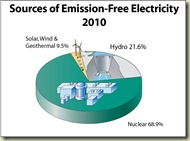
Photo: Sources of Emission-Free Electricity in the United States (2010).
The chairman explains:
“The goal of the CES is ambitious – a doubling of clean energy by 2035. But analysis has shown that the goal is also achievable and affordable. Meeting the CES will yield substantial benefits to our health, our economy, our global competitiveness and our economy,” Bingaman said.A fact sheet on the bill says the CES will only apply to retail utilities, not small utilities, and will be measured by the number of credits given to generators of clean energy. In other words, the higher the number of credits a utility has, the less emissions per unit of electricity. The fact sheet says:
This flexible framework naturally allows a wide variety of sources (solar, wind, nuclear, natural gas, coal with carbon capture and storage, etc.) to be used to meet the standard; allows market forces to determine what the optimal mix of technologies and fuels should be; and makes it easy for new technologies to be incorporated.
 Each energy source, depending on its emissions, would receive varied levels of credits. For instance, Platts explains:
Under [Sen. Bingaman’s] proposal, electricity generated by zero-carbon sources, such as wind, solar, geothermal, hydropower and nuclear, would get full credits.Whereas, Platts continues:
Electricity from coal-fired generation with carbon capture and storage or coal co-firing with biomass would receive partial credits if they emit fewer carbon emissions than 0.82 mt/megawatt-hour, the equivalent of new supercritical coal generation.The Platts article also points out that the credits could be accumulated and banked indefinitely, or transferred, traded or sold through an Energy Department trading system that would be set up as part of the legislation.
Sen. Bingaman, who is retiring at the end of this Congress, acknowledged that it may be difficult to get the legislation through both houses of Congress and to the president’s desk during this session. However, the White House’s spokesman Clark Steven praised today’s announcement as a step in the right direction:
“As the president has said consistently, a CES will drive innovation and investment in a range of clean energy sources — including renewables like wind and solar as well as nuclear, efficient natural gas and clean coal. A CES will also help America remain a leader in the clean energy economy, with all the jobs that it will bring. We look forward to working with Congress as the bill moves forward.”Several organizations today also publicly expressed similar views to the bill, including NextEra Energy’s Chairman and CEO Lew Hay:
“Senator Bingaman's bill provides the right incentives for the nation's electric utilities and equipment manufacturers to create good, high-paying jobs for American workers and for private capital to accelerate investment in innovative energy technologies. The bill's market-oriented standard would allow many different types of fuel sources to be competitive, while rewarding innovation, early action, efficiency and project execution.”For more information on the CES, see the Senate committee’s website for links to the press release, bill text, two-page summary, and section-by-section summary.
Photo: Sources of Emission-Free Electricity in the United States (2010).
Bill Gates Calls for More R&D Funding for Energy Technologies
 This week the Advanced Research Projects Agency-Energy (ARPA-E) held its third annual energy innovation summit in Washington, D.C., to discuss the future of energy technologies in the U.S. marketplace. Among the impressive lineup of speakers was a notable nuclear energy advocate Bill Gates, chairman of Microsoft and of the nuclear startup company TerraPower.
Although I wasn’t able to attend the conference in person (I found out too late—bummer!), I followed along on Twitter using the #eis12 hashtag to see what nuggets were said about the future of energy.
In a panel with Secretary Chu, Gates said that research and development for energy technologies is “greatly underfunded.”
"People underestimate how far away we are," Gates said. "That's partly why we can end up underfunding the innovative work that needs to go on."In order to get at least 10 to 20 technologies to succeed in the marketplace, Gates called for at least doubling the current budget for R&D to encourage the thousands of companies that may be needed to try their hands at developing the next big energy innovation.
Boosting funding for research doesn't guarantee that there will be a technological breakthrough, but it does improve the chances of speeding up progress. Still, Gates said, the failure rates of green-technology startups will be well over 90 percent.
He also said that it’s important that the United States continue developing cheaper, cleaner sources of energy if we want to help impoverished people around the world:
“If you look at improvement in the human condition, it really does have to do with energy. If you want to improve the livelihoods of the poorest 1 billion people in the world, having cheap energy [is a way to do it]. Can they afford transportation, fertilizer, lighting? The answer is no, without cheap energy, they stay stuck where they are.”As part of his commitment to developing clean energy, Gates reconfirmed his support for nuclear power as a viable, safe, emission-free energy source. Smart Planet explains:
“Unless you can take hydrocarbons and take extreme [carbon] capture-and-storage, then you’ve got nuclear as the one left [that provides baseload power],” he said. “I think we should bet on all of these, and in each area we should have ideally hundreds of companies betting on them.”Continuing to improve nuclear energy technologies to make them even safer will still be important, Gates said. Inga’s Live Blog explains:
“If you need humans to do something, that’s not a good design,” [said Gates]. Gates said nuclear isn’t dead. Next-gen nuclear plants will no doubt have safety procedures that don’t need people figuring out which switch to flip to stop a meltdown.Developing game-changing energy technologies will take time however, Gates explains, due to the necessary research and testing that is involved.
The problem with using IT and telecommunications as models for innovating in clean energy is that people underestimate the difficulty of the scientific work needed and how much time is needed for innovations to become adopted, Gates said.Beyond the time to research, the energy industry is subject to sometimes burdensome regulatory frameworks, which can also delay progress in the field, Gates said:
“Whatever technology they use and how it’s priced for consumers is determined on a regulatory basis,” he said. “It’s very different than having a software company or even a chip factory where your innovation cycles are every two or three years and your dependence on government policy is very low.”For more information on some of the current challenges facing the energy industry, watch the panel with Gates and Secretary Chu from the summit. For more information on the ARPA-E summit, check out CNET’s coverage.
Photo: Bill Gates at the ARPA-E 2012 summit. Credits: AFP/Getty Images.
Subscribe to:
Posts (Atom)