The Union of Concerned Scientists (UCS) has weighed in on the U.S. response to Fukushima and their conclusion is clear: We’re moving too slowly….No, wait, we’re moving too fast!...Check that, too slow!Scott also contributes on occasion to the Huffington Post.
Taking a page from Goldilocks, who couldn’t seem to find the right size chair, UCS can’t seem to find the right speed for applying lessons learned in the aftermath of the massive earthquake and tsunami that struck Japan a year ago.
After first praising the Nuclear Regulatory Commission for reacting quickly to the events in Japan, a new UCS report prods the agency to move faster. Then report declares that “speed is not always a virtue.” In the most remarkable twist of logic, UCS criticizes the nuclear energy industry for “acting too hastily by launching a voluntary program” to improve safety.
Really? Moving too quickly to improve safety?
At least the UCS report got something right. The industry is not waiting for orders from the NRC to act. Our FLEX strategy protects against the two main safety issues at Fukushima¬—the loss of electrical power and the loss of cooling capability—by stationing emergency backup equipment in multiple locations, including regional centers.
Every U.S. nuclear operator has committed to order additional equipment by the end of the month, and more than 300 pieces of backup emergency equipment has already been delivered or ordered. Rather than applauding these proactive safety measures, UCS complains that the industry is “jumping the gun” by getting ahead of the NRC.
The industry and the NRC are in general agreement on the issues that need to be addressed, but the regulatory process takes time. After the terrorist attacks on September 11, 2001, the NRC fast-tracked the industry’s safety response by issuing a series of orders, with a deadline of October 2004.
After the industry met that deadline, the NRC began a rulemaking process to codify the orders and essentially get its procedural/bureaucratic house in order. Along the way, it added a few more requirements that weren’t finalized until close to the end of the decade. In that case, UCS distorts the facts to complain that the industry’s response was too slow.
Now that we are moving even more quickly to respond to Fukushima, UCS says we are going too fast. Does UCS seriously believe we should just sit and wait while the NRC process unfolds? We see ways to strengthen our defenses against extreme events now, and we are acting. To do otherwise would be an abrogation of our responsibility.
The NRC will oversee our safety enhancements, and will not hesitate tell us to do something more or something different—backed by the agency’s full enforcement authority—as the regulatory process plays out.
That approach might not satisfy Goldilocks or UCS, but we think it is juuuuust right to ensure that lessons learned from Japan are applied as quickly and efficiently as possible.
Showing posts with label Nuclear Energy. Show all posts
Showing posts with label Nuclear Energy. Show all posts
Monday, March 12, 2012
UCS Channels Goldilocks In Response to Fukushima
NEI's Senior Vice President of Communications, Scott Peterson, passed along the following note concerning last week's report by the Union of Concerned Scientists, "U.S. Nuclear Power Safety One Year After Fukushima."

The Number 22

But a number of factors, according to the EIA, has pushed the relative percentages of several energy sources up because one went down rather dramatically, both statistically and practically.
That would be coal, which dropped from 46 percent in December 2010 to 39 percent in December 2011. The EIA says that the main driver of this decrease is the increased use of natural gas, which increased its share from 22 percent to 26 percent.
Electricity use itself declined 7 percent, so that in itself makes percentage increases and decreases a little chimerical – that is, nuclear generated roughly the same amount of electricity as last December but in a smaller marketplace – as did hydro, which advanced from 6 to 7 percent.
But the decline of coal in favor of natural gas is quite real: coal generation fell 21 percent compared to a 12 percent rise in natural gas generation. The last time coal fell below 40 percent in these surveys was in 1978.
So the news about nuclear energy might seem a numerical blip. But it’s not a trick, and it’s legitimate to note because it speaks to the steadiness of nuclear energy. We’ll have to keep an eye on the monthly report to see what happens when electricity usage returns to its former levels.
One Year Later

Two people died in industrial accidents at Fukushima Daiichi during or directly after the catastrophe. Japan’s National Police Agency currently counts 15,848 people dead and 3,305 people missing as a result of the twin disasters. That’s 19,153, a number that has risen and fallen during the last year.
We’ve talked about the accident at Fukushima Daiichi and its consequences often at this site and will continue to talk about it. But not today.
On the occasion of this anniversary, we should memorialize what the Japanese people will not forget. Nothing can replace loved ones, but surely the country will insist on a continuity of purpose and resolve. The Japanese people will reconstruct what was wrecked materially and we may hope that it will help salve what was damaged spiritually.
The News Observer has a roundup of pictures and captions that show the Japanese marking the anniversary and Talking Points Memo shows truly remarkable before-and-after photos of various locations directly after the earthquake and tsunami and today (including a shot of Fukushima Daiichi).
A boy lights a candle at a memorial service in Koriyama, Fukushima Prefecture. See here for more.
Thursday, March 8, 2012
A Good Time to Speed Up – Vietnam, Iowa, FOE
“We also have a good chance in Vietnam,” the minister added. “The United States, France, Canada, Russia, Japan and Korea can build nuclear power plants, but the U.S. lags behind in technology as it hasn’t built one for 20 to 30 years. This is a good time for us to speed up (atomic power plant construction).”
Ouch! That stung a little.
This is South Korea’s Knowledge Economy Minister Hong Suk-woo. He’s not exactly right – falling behind in construction and in technological advance are two different things and the U.S. has not fallen behind – at all – in technology. But Hong is selling Korean capacity in both, so fine. Still – ouch!
---
Land of corn and plenty:
Dueling videos debuted Wednesday on possible nuclear power expansion in Iowa.
A group that opposes nuclear power launched a television ad on the eve of today’s Senate committee hearing on a proposed compromise that advocates hope will push the bill ahead.
And minutes later, MidAmerican Energy released its own Web video, featuring Bill Fehrman, the company’s president and chief executive officer.
The opposing ad is from Friends of the Earth, our old FOEs. I generally find anti-nuclear advocates interesting if not always on target, but not FOE. It’s notably fact free.
But the pleasant surprise is that MidAmerican isn’t standing for it and has put its own ad in response. It’s simply done but that means there’s no manipulation or appeals to emotion. It’s simply Fehrman providing the company’s viewpoint:

---
Hey, South Korea was talking about Vietnam above, wasn’t it? Care to know just what Vietnam is up to these days?
"The consistent view of Vietnam is to utilize nuclear energy for peaceful purposes in a responsible manner while ensuring safety and security," [Le Dinh Tien, deputy minister of the Vietnamese Ministry of Science and Technology, which] is responsible for overseeing the country's nuclear power, said in January.
By 2030, Vietnam aims to build 10 reactors and, by 2050, it hopes to generate enough nuclear power to account for 20-25 percent of its energy consumption.
Now you know.
---
NEI’s main site and the Safety First site have been doing a good job of keeping you up to date on post-Fukushima information and updates (Safety First has a great infographic up right now showing how FLEX, the industry’s response to Fukushima, will work – poster worthy – really), but we’d be remiss not to note good work done by some of the nuclear companies out there.
If you have a few minutes, check out these pages by FPL (Florida Light & Power) and NextEra Energy to see how they are presenting nuclear energy, the accident in Japan and the drive to apply the lessons learned to their fleets. Both are very nicely done – corporate speak kept to a minimum, little to no attempt at spin. (We noticed FPL redid its nuclear energy launch page, too – a lot less text heavy and more inviting.)
“You had better adopt nuclear energy”

“Fifty percent of our electricity is produced by coal, 20 percent by nuclear power. Yet, when I look at your budget, I look at huge increases in renewable energy funding, which makes up only a small portion of our energy portfolio and cuts in the other area that’s producing most the electricity and frankly I’m disappointed,” Simpson said. “Seems to me like there is an agenda of trying to push green technology, when I think nuclear energy is green technology … you’re really going to address global climate change, you had better adopt nuclear energy and it doesn’t seem like we’re doing that in this budget. This is the first time I’ve seen a retrenchment in this administration in advancing nuclear energy. The talk is all there, but the budget doesn’t reflect that.”
Like Rep. Simpson, the industry was disappointed with the 2013 budget request for nuclear energy. Even if one thinks that nuclear energy should take a financial hit as a result of the accident at Fukushima Daiichi, the response will largely be directed by the industry and regulators. The United States remains committed to nuclear energy and its technological advancement, so imposing a kind of slowdown doesn’t help the country achieve its long term energy goals – Simpson’s main point.
And Simpson’s right – achieving carbon reduction goals on renewables alone would go far more slowly than with nuclear energy in the mix. Though no one is threatening to shutter the American nuclear industry – just the opposite, in fact - slowing progress makes no real sense. What’s that? Did someone say Germany?
---
Germany's abrupt change in nuclear policy has put a dent of €1.3 billion ($1.7 billion) in RWE's results for FY2011. It also boosted power prices and raised carbon dioxide emissions, the company said in its annual report to shareholders.
That’s from World Nuclear News. The story is largely about RWE’s earnings report, but there were a few telling tidbits. For example:
Among the figures moving upwards was the amount of carbon dioxide produced by RWE for each unit of electricity. This went up 8.2% from 0.732 to 0.787 tons per MWh "mainly because our Biblis nuclear power station stopped operating," it said.
Rep. Simpson, take note.
RWE linked the nuclear shutdown and a general rise in the cost of fuel to a hike in wholesale power prices. It said that the price of base-load power on the EEX Energy Exchange in 2011 had averaged €51 ($66) per MWh and peaked at around €61 ($80) per MWh. These figures represent increases of 16% and 10% on 2010 figures of €44 and €55 ($57 and $72) per MWh.
And the energy outlook is grim:
Looking ahead, RWE is focusing research and development efforts on carbon capture and storage techniques because, "by the end of 2022, all German nuclear power stations will be offline and the gap they leave cannot be closed by renewable energy and increased electricity imports alone."
Well, maybe CCS will be ready to roll by 2022 – cost and scalability questions still abound - but RWE is really betting the farm on it. And if it’s wrong? Then what does it do?
Germany is shaping up to be quite the case study.
---
Scotland would like to shut its two nuclear facilities in favor of CCS, too, and renewables. How? Apparently, by sheer force of will:
Scottish energy minister Fergus Ewing acknowledged that the government's 100% renewables target has been met with "doubt and skepticism," but said Scotland would rise to these challenges. "I want to debate, engage and co-operate with every knowledgeable, interested and concerned party to ensure we achieve our goals," he said.
To doubt and skepticism, I’d add mirthless laughter.
Germany’s Biblis nuclear energy facility.
Monday, March 5, 2012
The Small Reactors at Savannah River
 The Department of Energy proposed a couple of years ago spurring the development of small nuclear reactors by entering public-private partnerships with several vendors to foster the building of prototypes and, eventually, generate NRC license applications for the designs.
 Now, the first fruit of this program has budded:
Hyperion Power Generation Inc., the Department of Energy – Savannah River, and Savannah River National Laboratory have announced their commitment to deploy a privately-funded first-of-a-kind Hyperion reactor at the DOE Savannah River Site.Hyperion doesn’t need a license to pursue its work, as it could sell its reactor technology overseas if it chose and go through whatever processes are established in other countries. But it recognizes the value of the NRC’s license procedure as a kind of gold standard:
“It is important that we achieve NRC licensing to provide worldwide confidence in the technology and design of our advanced Generation 4 reactor,” said Dave Carlson, COO and Chief Nuclear Officer with HPG.Let’s back up over the news a little bit.
Hyperion joins NuScale and Holtec International among the companies included in the DOE program. The work by all three companies will be done at South Carolina’s Savannah River Site. NuScale and Hyperion have small reactor designs.
So does Holtec, which I’ve generally regarded as a parts fabrication company. Holtec’s HI-SMUR 140 is a 140-megawatt reactor with an underground core. The design requires no reactor coolant pump or off-site power to cool the reactor core.
A little more about what the announcements mean:
The agreements will allow these private companies to gain information on SMR reactor deployment at SRS and offer a framework to develop land use and site services contracts to promote these initiatives. The MOUs help to leverage Savannah River’s nuclear expertise, energy facilities and land assets that support private sectors to develop, test and license prototype SMR technologies.That’s a chunk of acronyms – MOU is memorandum of understanding, the agreements between Savannah River Site and the companies, presumably to be followed by contracts.
World Nuclear News expands on this a bit:
However, the DoE stressed that the new agreements "do not constitute a federal funding commitment." It said that it envisages private sector funding to be used to develop these technologies and support deployment plans. The DoE added that the agreements are unrelated to its funding opportunity announcement for SMR cost-share projects announced in January.This forward-looking projects will be interesting to follow, something I’m sure the three companies and DOE will be eager to help us do.
---
A speech given about the Canadian response to the accident at Japan’s Fukushima Daiichi site is an interesting echo of the American response, with the Canadian Nuclear Safety Commission in the role of the NRC and the World Association of Nuclear Operators playing INPO (and INPO playing INPO, too.)
The speaker is Tom Mitchell, the President and CEO of Ontario Power Generation. The following excerpts are adapted from notes he put together for the speech. You can read the whole thing here. (I like that the Canadians use the term learnings for lessons learned,too.)
Much has been written about Fukushima – some of it critical of our industry. Yet as I look back at events over the past year, I believe our reaction to Fukushima was timely, appropriate and effective.I’m not sure of the CNSC’s role – it may not carry the same regulatory heft of the NRC or perhaps Sullivan just wanted to stress his company’s activities.
Right from the start, here in Canada we moved quickly to give people as many facts as possible about the event – and assure them of the safety of our nuclear units. The CNA was very active during this period. So was OPG as well as our nuclear colleagues.
At OPG, we communicated quickly and across a number of fronts --- with local communities and on regional, national and international level. We dedicated a portion of our website to the event – providing fact-based information about the event and our stations. We made our executives available for speeches and interviews. We did extensive outreach in our nuclear site communities. We published information pieces in local and regional newspapers. And we established regular and ongoing communications with nuclear organizations from around the world – including WANO (World Association of Nuclear Operators), INPO (Institute of Nuclear Power Operations) and the IAEA (International Atomic Energy Agency).
Our message was clear.
The geology at our sites was stable and our nuclear safety systems were robust – with redundant back-up power so that we were not vulnerable to Fukushima-type acts of nature.
The CNSC (Canadian Nuclear Safety Commission) was also active.
Shortly after the event, it asked Canadian nuclear operators to provide verification their reactors were safe. The CNSC also provided information on its website that was useful to both the industry and the general public. In response to the CNSC’s request, OPG and other operators launched a thorough assessment of their operations to confirm their safety.
We also committed to a number of specific actions based on lessons learned from Fukushima. By April, we had reconfirmed that our stations were indeed safe and the systems in place at OPG’s nuclear facilities were robust enough to withstand significant emergencies. In July we issued another report in which we outlined the steps we were taking to address the key learnings coming out of Fukushima. These learnings included the absolute necessity to guard against external events – specifically those that threaten to overwhelm the design basis of the plant’s systems and equipment.
There’s a section of the speech about the CANDU (which stands for Canada Deuterium Uranium) reactor, the country’s home-grown variation on a pressurized heavy water reactor. Canada has 18 operating reactors, 16 in Ontario, one in Quebec and one in New Brunswick. All are CANDUs. Canada has also sold about 32 CANDUs to other countries. None are in the United States. You can read more about the CANDU reactor here.
Nuclear energy provides about 15 per cent of the country’s electricity and 50 percent of Ontario’s electricity.
---
Well:
Congress and Bharatiya Janata Party (BJP) cadres hurled stones on anti-nuclear energy protesters here on Saturday. A police constable, Murugesan (45), suffered head injuries in the incident.The story in The Hindu offers more details but not enough context to understand why government pelting occurred here. Apparently, the protest involves the building of the Kudankulum facility in Tamil Nadu, which has indeed become contentious, but that’s all I can figure out. Let’s file this one away until more information surfaces. In the meantime: no pelting.
The Hyperion Power Module is actually the little pellet-like element indicated by the arrow in this conceptual drawing.
Sunday, March 4, 2012
94th Carnival of Nuclear Energy – Old Battles, New Technologies and One Scandal
Last week was another busy week in social media. Today we’re hosting the 94th carnival and highlighting 21 posts from 14 blogs.
To start, Gail Marcus at Nuke Power Talk discusses her concerns about the zeroing of funds for nuclear engineering education programs in the 2013 budget request. It’s been an annual battle to maintain the nuclear education programs at the NRC and DOE and this year was no different. From Gail:
It seems to me that in general, it is penny-wise and pound-foolish for a nation to skimp on education. I know the budget is tight and I know there are many other important programs, but we really can't stop looking ahead.
The case for nuclear engineering education is particularly important. The current workforce of nuclear engineers is rapidly retiring. … One hopes that some of the supporters of nuclear energy on the Hill will notice this cut and restore the funding. I would encourage those who share my concern to contact your members of Congress and ask for their help in restoring funding for educational programs.
Hear, hear!
…
 Meredith Angwin at Yes Vermont Yankee wrote a guest post at the ANS Nuclear Cafe describing the controversies around VY. She notes that “putting Vermont Yankee issues in context is like facing a huge mountain range. There is always another set of hills beyond this one.”
Also at her own blog, she announced the March 17 community rally in support of the plant.
…
Steve Aplin at Canadian Energy Issues commented on the different risk perceptions between nuclear materials and chemicals. Fear of the 'Dirty Bomb' recently led to a campaign to phase out the use of cesium-137 in hospital irradiators. Those machines sterilize blood prior to transfusion and prevent transfusion-associated diseases. Steve pointed out that there have not been similar campaigns to phase out other useful chemicals, like chlorine, ammonium nitrate and gasoline, which are much easier to obtain and put to evil purposes than cesium. Many people fear nuclear materials but forget that chemicals, fuel and fertilizers can cause much greater damage.
…
Atomic Power Review has a two-part contribution this week concerning the Palisades nuclear station and reactor pressure vessel embrittlement. In the two posts, Will Davis addressed media claims of vessel embrittlement. Part 1 was a background on Palisades with a link to a past APR article on the topic and part 2 provided great detail on embrittlement from a number of print sources and A. David Rossin (former President of ANS).
…
 Filling in for Charles Barton at Nuclear Green, NNadir shares his thoughts on the first nuclear reactors in the world that naturally fissioned a few billion years ago. Although there is a lot of squabbling about burying nuclear waste, nature proves it can be contained. From NNadir:
Over two billion years, most of the fission products in porous sandstone at Oklo didn't even migrate as far as Tom Brady can throw an errant football in a "Hail Mary" pass at the end of a Superbowl as a last ditch attempt to avoid a losing effort.
His post is humorous and dense but definitely worth the read on Oklo.
…
Steve Skutnik from the Neutron Economy describes how small modular reactors can help displace Iowa's coal-heavy energy portfolio. SMRs can provide an economical, "right-sized" solution for smaller, rural electrical grids like Iowa’s. Of course, not everyone is convinced of the benefits. Skutnik also blasted some of the specious arguments against the technology.
…
Over at Energy From Thorium, Kirk Sorensen is working hard to push for thorium all around the world. Kirk was in London last year to help launch the Weinberg Foundation which promotes thorium. On Thursday, Kirk highlighted the Foundation’s press release on the formation of an “All-Party Parliamentary Group” in London with members of both the House of Commons and House of Lords to consider the potential of thorium as an energy source. Well done.
…
Rod Adams at Atomic Insights discusses how and why we should combine domestic coal with nuclear energy to make oil.
My pitch to the coal industry would be to use cheap, clean nuclear heat to convert H2O and their carbon rich fuel into a refined hydrocarbon that could compete with petroleum products.
No, it’s not a new concept. Technologies exist to achieve this, check out Rod’s post on how.
…
How close did Japan really get to a widespread nuclear disaster? At Brave New Climate, Barry Brook highlights a post at Slate.com by two authors at the Breakthrough Institute who put Fukushima into a proper context. Barry adds:
Much of the post-accident speculation was constrained only by people’s imagination (which can be pretty wide ranging), and utterly failed to resolve the fact that RISK is probability X impact. Instead, anti-nuclear types typically choose a huge, speculative impact, and then try to attach a large probability (often near certainty) to it. For truly catastrophic outcomes, both numbers are very small, and multiplied, vanishingly so.
Can’t add to that.
…
We have two posts to mention from the ANS Nuclear Café. Wesley Deason launched his series on the uses of nuclear fission to enable human space exploration beyond earth’s orbit:
Nuclear reactors, due to their ability to produce large amounts of energy at any location, will be the required energy source for future human space travel outside of earth’s orbit.
Make sure to follow the Café for more of his series.

…
Dan Yurman at his own blog, Idaho Samizdat, also reported several positive news items for the week including the good news that North Korea is suspending its nuclear weapons program and opening more dialogue with the U.S. Of course, some aren’t holding their breath.
Dan also reported that Iran is having a tough time with its uranium enrichment program, how the U.K. is consuming its surplus plutonium, and how South Africa is taking another shot at bids for new reactors in the country.
…
Brian Wang at Nextbigfuture looked at detailed levelized cost comparisons of nuclear, solar and coal. Brian notes that two-thirds of the cost of coal energy is determined by future commodity prices while nuclear and solar costs are dominated by construction costs and financing.
Brian also highlights a World Nuclear News story on GE’s laser uranium enrichment plant. The NRC just issued its final technical Safety Evaluation Report (SER) and Environmental Impact Statement (EIS) for the proposed enrichment plant.
The GLE plant would use a laser-based process to enrich uranium up to 8% uranium-235 by weight (although nuclear power reactors normally require 3%-5% enriched uranium), with an initial planned maximum target production of six million separative work units (SWU) per year. … Laser enrichment could be 2 to 20 times more efficient than other enrichment processes.
Sweet.
…
And here at NEI Nuclear Notes, various contributors generated a lot of action – covering PBS’ documentary of Fukushima, Senator Bingaman’s proposed Clean Energy Standard, tornadoes in the South, and NEI’s next social media call on the industry’s FLEX strategy.
Be sure to stop by everyone’s pages for these great articles and new reporting. Stay tuned for other carnivals at Yes Vermont Yankee, ANS Café, Next Big Future and Atomic Power Review!
Friday, March 2, 2012
NEI to Host Blogger Conference Call on FLEX
The Nuclear Energy Institute will be hosting a conference call for bloggers with NEI's Adrian Heymer on FLEX, the U.S. industry's strategy to enhance safety at its nuclear energy facilities. The call will be conducted from 11 a.m. to 12 p.m. on Friday, March 9 and will be hosted by Dan Yurman of Idaho Samizdat.
All participants must pre-register in order to dial in to the call. Please RSVP to my NEI email address at epm-at-nei.org by COB Thursday, March 8 in order to reserve your space.
Please submit your questions prior to the call, as they'll be asked by Mr. Yurman in much the same manner as the call he hosted with NRC Chairman Greg Jaczko. If the program runs long don't fret, as we'll post answers to any question we don't get to here on the NEI Nuclear Notes blog.
For those of you who might not be familiar with Mr. Heymer, here's a short bio. Here in the U.S., there simply isn't anyone with a better read on how the incident at Fukushima is impacting the way our industry does business than Mr. Heymer.
Adrian Heymer is the Executive Director, Strategic Programs, at the Nuclear Energy Institute (NEI). In this position he serves as the industry's point person in organizing an integrated response to the events at Fukushima Daiichi. Other responsibilities at NEI have encompassed new nuclear plant deployment, electricity deregulation, plant performance improvement, risk-informed regulation and industry quality programs. Prior to joining NEI he worked in support of Nebraska Public Power District’s Cooper Nuclear Station, Nebraska; at Lloyds Register on technical certifications and inspections; and served in the Royal Navy.
We're all looking forward to your questions. See you on March 9 at 11 a.m.
All participants must pre-register in order to dial in to the call. Please RSVP to my NEI email address at epm-at-nei.org by COB Thursday, March 8 in order to reserve your space.
Please submit your questions prior to the call, as they'll be asked by Mr. Yurman in much the same manner as the call he hosted with NRC Chairman Greg Jaczko. If the program runs long don't fret, as we'll post answers to any question we don't get to here on the NEI Nuclear Notes blog.
For those of you who might not be familiar with Mr. Heymer, here's a short bio. Here in the U.S., there simply isn't anyone with a better read on how the incident at Fukushima is impacting the way our industry does business than Mr. Heymer.
Adrian Heymer is the Executive Director, Strategic Programs, at the Nuclear Energy Institute (NEI). In this position he serves as the industry's point person in organizing an integrated response to the events at Fukushima Daiichi. Other responsibilities at NEI have encompassed new nuclear plant deployment, electricity deregulation, plant performance improvement, risk-informed regulation and industry quality programs. Prior to joining NEI he worked in support of Nebraska Public Power District’s Cooper Nuclear Station, Nebraska; at Lloyds Register on technical certifications and inspections; and served in the Royal Navy.
We're all looking forward to your questions. See you on March 9 at 11 a.m.
Thursday, March 1, 2012
Sen. Bingaman Announces Clean Energy Standard Act of 2012
Senate Energy and Natural Resources Committee Chairman Jeff Bingaman (D-N.M.) unveiled the Clean Energy Standard Act of 2012 today to steer the country in a direction of reducing overall carbon emissions. The bill aims for large power companies to begin increasing their electricity output from low-carbon sources like wind, solar, nuclear energy and natural gas by 2015, with the overall goal of producing 84 percent of their overall electricity from low-carbon sources by 2035.
The chairman explains:
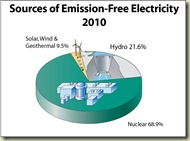 Each energy source, depending on its emissions, would receive varied levels of credits. For instance, Platts explains:
Sen. Bingaman, who is retiring at the end of this Congress, acknowledged that it may be difficult to get the legislation through both houses of Congress and to the president’s desk during this session. However, the White House’s spokesman Clark Steven praised today’s announcement as a step in the right direction:
Photo: Sources of Emission-Free Electricity in the United States (2010).
The chairman explains:
“The goal of the CES is ambitious – a doubling of clean energy by 2035. But analysis has shown that the goal is also achievable and affordable. Meeting the CES will yield substantial benefits to our health, our economy, our global competitiveness and our economy,” Bingaman said.A fact sheet on the bill says the CES will only apply to retail utilities, not small utilities, and will be measured by the number of credits given to generators of clean energy. In other words, the higher the number of credits a utility has, the less emissions per unit of electricity. The fact sheet says:
This flexible framework naturally allows a wide variety of sources (solar, wind, nuclear, natural gas, coal with carbon capture and storage, etc.) to be used to meet the standard; allows market forces to determine what the optimal mix of technologies and fuels should be; and makes it easy for new technologies to be incorporated.
 Each energy source, depending on its emissions, would receive varied levels of credits. For instance, Platts explains:
Under [Sen. Bingaman’s] proposal, electricity generated by zero-carbon sources, such as wind, solar, geothermal, hydropower and nuclear, would get full credits.Whereas, Platts continues:
Electricity from coal-fired generation with carbon capture and storage or coal co-firing with biomass would receive partial credits if they emit fewer carbon emissions than 0.82 mt/megawatt-hour, the equivalent of new supercritical coal generation.The Platts article also points out that the credits could be accumulated and banked indefinitely, or transferred, traded or sold through an Energy Department trading system that would be set up as part of the legislation.
Sen. Bingaman, who is retiring at the end of this Congress, acknowledged that it may be difficult to get the legislation through both houses of Congress and to the president’s desk during this session. However, the White House’s spokesman Clark Steven praised today’s announcement as a step in the right direction:
“As the president has said consistently, a CES will drive innovation and investment in a range of clean energy sources — including renewables like wind and solar as well as nuclear, efficient natural gas and clean coal. A CES will also help America remain a leader in the clean energy economy, with all the jobs that it will bring. We look forward to working with Congress as the bill moves forward.”Several organizations today also publicly expressed similar views to the bill, including NextEra Energy’s Chairman and CEO Lew Hay:
“Senator Bingaman's bill provides the right incentives for the nation's electric utilities and equipment manufacturers to create good, high-paying jobs for American workers and for private capital to accelerate investment in innovative energy technologies. The bill's market-oriented standard would allow many different types of fuel sources to be competitive, while rewarding innovation, early action, efficiency and project execution.”For more information on the CES, see the Senate committee’s website for links to the press release, bill text, two-page summary, and section-by-section summary.
Photo: Sources of Emission-Free Electricity in the United States (2010).
Bill Gates Calls for More R&D Funding for Energy Technologies
 This week the Advanced Research Projects Agency-Energy (ARPA-E) held its third annual energy innovation summit in Washington, D.C., to discuss the future of energy technologies in the U.S. marketplace. Among the impressive lineup of speakers was a notable nuclear energy advocate Bill Gates, chairman of Microsoft and of the nuclear startup company TerraPower.
Although I wasn’t able to attend the conference in person (I found out too late—bummer!), I followed along on Twitter using the #eis12 hashtag to see what nuggets were said about the future of energy.
In a panel with Secretary Chu, Gates said that research and development for energy technologies is “greatly underfunded.”
"People underestimate how far away we are," Gates said. "That's partly why we can end up underfunding the innovative work that needs to go on."In order to get at least 10 to 20 technologies to succeed in the marketplace, Gates called for at least doubling the current budget for R&D to encourage the thousands of companies that may be needed to try their hands at developing the next big energy innovation.
Boosting funding for research doesn't guarantee that there will be a technological breakthrough, but it does improve the chances of speeding up progress. Still, Gates said, the failure rates of green-technology startups will be well over 90 percent.
He also said that it’s important that the United States continue developing cheaper, cleaner sources of energy if we want to help impoverished people around the world:
“If you look at improvement in the human condition, it really does have to do with energy. If you want to improve the livelihoods of the poorest 1 billion people in the world, having cheap energy [is a way to do it]. Can they afford transportation, fertilizer, lighting? The answer is no, without cheap energy, they stay stuck where they are.”As part of his commitment to developing clean energy, Gates reconfirmed his support for nuclear power as a viable, safe, emission-free energy source. Smart Planet explains:
“Unless you can take hydrocarbons and take extreme [carbon] capture-and-storage, then you’ve got nuclear as the one left [that provides baseload power],” he said. “I think we should bet on all of these, and in each area we should have ideally hundreds of companies betting on them.”Continuing to improve nuclear energy technologies to make them even safer will still be important, Gates said. Inga’s Live Blog explains:
“If you need humans to do something, that’s not a good design,” [said Gates]. Gates said nuclear isn’t dead. Next-gen nuclear plants will no doubt have safety procedures that don’t need people figuring out which switch to flip to stop a meltdown.Developing game-changing energy technologies will take time however, Gates explains, due to the necessary research and testing that is involved.
The problem with using IT and telecommunications as models for innovating in clean energy is that people underestimate the difficulty of the scientific work needed and how much time is needed for innovations to become adopted, Gates said.Beyond the time to research, the energy industry is subject to sometimes burdensome regulatory frameworks, which can also delay progress in the field, Gates said:
“Whatever technology they use and how it’s priced for consumers is determined on a regulatory basis,” he said. “It’s very different than having a software company or even a chip factory where your innovation cycles are every two or three years and your dependence on government policy is very low.”For more information on some of the current challenges facing the energy industry, watch the panel with Gates and Secretary Chu from the summit. For more information on the ARPA-E summit, check out CNET’s coverage.
Photo: Bill Gates at the ARPA-E 2012 summit. Credits: AFP/Getty Images.
Wednesday, February 29, 2012
New NEI White Paper: Making Safe Nuclear Energy Safer
With the anniversary of the incident at Fukushima Daiichi almost upon us, it's only natural for the public and other stakeholders to be asking questions about the safety of America's nuclear energy facilities. To answer those questions, NEI has published a white paper entitled, "Making Safe Nuclear Energy Safer."
The following passage is from the document's Executive Summary:
The following passage is from the document's Executive Summary:
The nuclear energy industry’s primary and constant goal is to make safe nuclear energy facilities even safer. A decades-long commitment to safety and continuous learning is reflected in the operational focus and safety culture at our facilities. Companies that operate 104 U.S. reactors review safety procedures continually and update their facilities and training programs with lessons learned from those reviews.The paper clocks in at nine pages in length, and is easily digestible for readers who, while they might be aware of the accident at Fukushima Daiichi, might not be completely up to speed on what the Nuclear Regulatory Commission and U.S. industry have been doing in the interim to apply lessons learned from our colleagues in Japan. Click here to download it right now.
The industry has a commitment to safety because nuclear energy is a vital part of America’s electricity portfolio. It helps achieve greater energy independence for America and produces affordable, reliable electricity for one of every five Americans. Safety is the foundation of a thriving nuclear energy industry in America and globally—with more than 430 reactors producing electricity and 65 plants under construction.
After the March 11, 2011, earthquake and tsunami in Japan, the U.S. nuclear power industry is looking even more closely at ways to ensure safety is maintained in the face of extreme natural events. The U.S. industry and our global partners took immediate actions after the events in Japan, both to support the recovery of the Fukushima Daiichi reactors and to review critical safety systems at U.S. reactors. While we continue to monitor the situation closely and to learn from it, the nuclear energy industry in the United States is already implementing numerous measures to maintain and upgrade the already-high level of safety at nuclear energy facilities.
Friday, February 24, 2012
Breakers in the Solar Wave

For Germany, one of those ways has been encouraging the uptake of renewable energy. But now, the plummeting price of solar panels has unleashed a new round of, how shall we put it, chaos.
Germany plans to reduce government subsidies supporting solar power by up to 30 percent within a year because higher-than-expected demand has made the scheme far more costly than authorities initially expected.
At first glance, that seems a boon to the solar business and a vindication of those subsidies – they seeded the market and now the market can proceed on its own. But not so.
German companies producing solar panels, already under pressure from stiff competition from new manufacturers in China, protested against the new cuts. Several thousand employees of about 50 firms in the segment held protest rallies across the country, the German Solar Industry Association said.
Now, this could simply be a case of not wanting the money spigot turned off – that’s not unusual. The growth of solar energy in Germany in impressive but seems containable: installations ran to 7500 megawatts in capacity last year, more than double the 3500 megawatts the government expected to see (and based its subsidy system around.) Remember that solar power cannot achieve 50 percent of its capacity rating, so those numbers are a little deceptive on their face. Nuclear energy facilities, by contrast, achieve above 90 percent of its capacity rating routinely.
Beyond these issues, the subsidies have put considerable pressure on the price benefit from the installations, essentially erasing the savings for ratepayers:
Installations of solar panels have boomed due to feed-in tariffs, generous subsidies which have mounted into a growing burden passed on to energy consumers.
Clearly the economics of solar power have gone haywire, but how?
Here’s the beginnings of an answer, from Morningstar:
Looking forward, we expect module pricing will begin falling within the next month, and reiterate our projection that module prices will be in the mid-$0.80s by summer. At such pricing levels, even a company with best-in-class production costs will not be able to turn a net profit this year. We reiterate our belief that for now long-term investors should steer clear of the space.
That’ll help, won’t it? Other financial gurus take equally dire views. The prediction is that there will be a wave of bankruptcies followed by a retrenchment. Here’s the bankruptcy part.
That will inevitably lead to more bankruptcies in a sector already laboring under 100 percent or more over-capacity and where leading names have filed for insolvency, including U.S.-based Evergreen Solar and Solyndra, and debt restructurings such as the one at Germany's Q-Cells.
And the retrenchment part.
But further cost cuts across the supply chain - and in particular the upstream manufacturers of raw solar-grade silicon - will sharpen the technology's competitiveness and see it mount a serious attack on offshore wind, shaking up the relative outlook for emerging technologies.
I’d add here that this shakeout holds the potential to strangle the solar panel business in Germany in the face of competition from China – what those protestors are rightly worried about - and losing a nascent business sector in a nascent technology would be an unquestionably poor outcome. But what about that serious attack on offshore wind?
If solar economics can leapfrog those of offshore wind, this poses the question: why invest in such a complex, moving piece of machinery as an offshore turbine, stationed in an unpredictable weather environment with massive servicing costs, rather than a simpler, static and more proven solar panel array?
One answer is that there may be more limited space for solar panels in the best, south-facing spots compared with the available coastlines suited for offshore turbines.
So – maybe. Note that Germany is far from being a sun-and-fun kind of place – this argument for solar is actually more solid for the United States.
I may be wrong, but this sounds like an instance where a business gambled that it would have a substantial product to sell but has ended up with the equivalent of a widget – and what company, especially one with considerable worker needs, can survive with a single widget as its product line?
This will shake out. Watching it do so is likely to be incredibly painful, especially in Germany, and a real blow to the solar energy business just when, ironically, it is gaining traction. In the meantime, chaos – Germany has blown a giant hole into its energy outlook.
---
You win some, you lose some:
Kuwait has decided to abandon civilian nuclear power production.
Abandon in this case means not build. Kuwait thought it might build four reactors by 2020 but has changed its mind.
We wrote about Kuwait’s plans two summers ago, based on this bit of news:
Kuwait is experiencing almost emergency conditions after power consumption hit an all-time high for the third day in a row at 10,921 megawatts at 2:30 pm, which is around 30 megawatts short of maximum production capacity. The record consumption was triggered by record temperatures that reached 51 degrees Celsius at Kuwait Airport, 50 degrees in Kuwait City and as high as 53 degrees at the Abdali border post with Iraq.
53 degrees Celsius is 127 degrees Fahrenheit. Kuwait asked its neighbors for help but didn’t get much.
So, this is Kuwait:
About a quarter of Kuwait's power is generated from gas. The rest is from oil. Besides the exorbitant cost, the use of fuel oil has a major environmental impact and Kuwait City is often shrouded in a brown haze.
I’ve lost track of who lost what here.
Neighborhood as solar array in Germany.
Wednesday, February 22, 2012
Thorium Faces the Hurdles on the Course

it’s not exactly an earlier Beta-VHS feud, though standardization doubtless had something to do with the decision to use uranium. Also, thorium has a somewhat more complex fuel cycle: it has no fissile isotopes, so must always be seeded by uranium or plutonium to be useful – they convert the thorium to uranium-233, which is fissile.
But why use thorium at all, especially since using it does not foreclose the use of uranium?
The Washington Post takes a stab at it:
[Thorium] is less radioactive than the uranium that has always powered U.S. plants, and advocates say that not only does it produce less waste, it also is more difficult to turn into nuclear weapons.
Another point: there’s a lot of mined thorium in the world – almost all of it unused. We ran a post awhile ago about a rare metal mining operation called Pea Ridge that was positively stuffed to the brim with thorium – and had no market for it.
More on the thorium reactor:
“A molten-salt reactor is not a pressurized reactor,” said John Kutsch, director of the Thorium Energy Alliance, a trade group based in Harvard, Ill. “It doesn’t use water for cooling, so you don’t have the possibility of a hydrogen explosion, as you did in Fukushima.”
Kutsch calls the molten-salt reactor a “liquid-fluoride thorium reactor,” and if thorium boosters really want to use it here, they’ll have to get it through the design licensing process at the NRC. That takes time, is resource intensive and requires a company to sit tight while the bills pile up.
Those aren’t reasons not to do it, or even reasons to become discouraged, but new designs from startup companies are a tough proposition. There’s fuel fabrication plants to build and license – that takes time – and coping with an energy and manufacturing infrastructure that has been built to support light water reactors. There are a lot of hurdles on this race course. (Not that the United States and the NRC are the only ways forward – see the recently licensed AP1000 for a counter example.)
But is it impossible to clear those hurdles? No.
---
Interestingly, the Post actually seeks out someone to bad mouth thorium, which is like dropping an anvil on a kitten. What’s the point?
“There are small boatloads of fanatics on thorium that don’t see the downsides,” said Dan Ingersoll, senior project manager for nuclear technology at the Oak Ridge National Laboratory in Tennessee. For one thing, he said, it would be too expensive to replace or convert the nuclear power plants already running in this country: “A thorium-based fuel cycle has some advantages, but it’s not compelling for infrastructure and investments.”
Ingersoll has a strong point here: thorium is fun to knock around because it is an element with a fan base, not just advocates and companies working on it. That can give it an air of frivolity. But his points against it only resonate if we freeze technology in place and go no further. From this perspective, it’s almost as if thorium were dismissible because it has a strong case.
And it isn’t really dismissible. “Replace or convert” need not be the only options (although replace seems eminently doable as older facilities retire some years hence). A lot of new designs are percolating through the small reactor community – TerraPower, Hyperion – so the thorium fuel cycle is not really so outlandish.
Be sure to check out the Thorium Energy Alliance here. (That web site, though. Oof!)
---
Visit the Weinberg Foundation (in England) for some more hard core thorium advocacy. It even has a quote from Baroness Worthington:
The world desperately needs sustainable, low carbon energy to address climate change while lifting people out of poverty. Thorium fuelled reactors, such as the Molten Salt Reactor (MSR) pioneered by the late Alvin Weinberg, could radically change perceptions of nuclear power leading to widespread deployment.
The baroness is an environmental activist in the House of Lords. So there you go. Alvin Weinberg, who died in 2006, was a nuclear physicist also much in favor of thorium.
The Baroness Bryony Worthington.
Thursday, February 16, 2012
Resurgence in American Nuclear Industry To Start in Ga., Says Energy Chief

“In his State of the Union address, President Obama outlined a blueprint for an American economy that is built to last and develops every available source of American energy,” said Secretary Chu. “Nuclear power is an important part of that blueprint. The work being done in Georgia and at research organizations like Oak Ridge National Laboratory is helping restore American leadership in the global race for the nuclear energy jobs of tomorrow.”
Just how many new jobs is Secretary Chu talking about? Business Week says:
About 1,700 workers are already on the job site and plant managers say that number will grow to nearly 5,000 at the peak of construction. Once the completed units go online, they will employ about 800 permanent workers.
Those numbers only capture the direct jobs from the project, but indirectly, Business Week explains that constructing the two new reactors means a lot more people coming to the area, consuming more goods and services at local businesses. Take, for example, Allen DeLaigle:
"Plant Vogtle has pretty well saved Burke County," said Allen DeLaigle, who owns and manages an RV park with his twin brother about 4 miles from the nuclear plant.
Since site preparation ramped up for the new units, DeLaigle's park has filled about 90 of its 151 spaces with RVs and campers owned by workers coming in from other states such as Alabama and Mississippi, West Virginia and Ohio.
Or Robin Baxley:
Robin Baxley, owner of a Waynesboro office supply store, added two new employees to keep up with deliveries of pens, paper, marker boards and thumb drives to the modular offices set up on the construction site. Her business also supplied the cubicles, desks and file cabinets for many of those temporary offices
"They helped us make it through the economic downturn," Baxley said. "Office furniture is not the first thing people buy when they can hardly make payroll."
The project also will create approximately 35,000 jobs for suppliers and manufacturers, which is why groups like the National Association of Manufacturers wholeheartedly support the project:
Manufacturers use one-third of the energy consumed in the Unites States, so building new reliable sources of energy is essential to our competitiveness. Building new nuclear power plants also means the creation of quality jobs for Americans at a time when we need them the most. The Vogtle plant alone will create 5,000 new jobs and will have a tremendous positive impact for the many jobs in the nuclear energy supply chain.
The amount of jobs this project is creating has not gone unnoticed by the public. In fact, on the day of the announcement, I took a phone call from a member of the public asking where he could find information online to apply for a job. I also saw comments like this one on Twitter:

If the overall goal is to create new jobs, make America more competitive and invest in an emission-free, domestic energy source, then this is the way to do it, said Secretary Chu on the tour:
“America has the opportunity to lead the world in clean energy technologies and to provide a foundation for our future prosperity. What you are doing here at Vogtle will help us compete in the global clean energy race and provide domestic, clean power to U.S. homes.”
During his visit to the site, Secretary Chu announced a funding opportunity of up to $10 million for research and development toward advanced nuclear reactor and fuel cycle technologies and also announced that the agency will be putting together an internal working group—chaired by Peter Lyons—to recommend a nuclear waste strategy to the secretary by the summer.
Continuing with his busy week, today the secretary testified before the Senate Energy and Natural Resources committee on the agency’s fiscal year 2013 budget request. (See the committee’s archived webcast and Secretary Chu’s testimony for more information.)
Photo: Southern Co.’s Tom Fanning and Energy Secretary Steven Chu on a tour of the Plant Vogtle site. Photo courtesy of Southern Co.
Nuclear Fact Check: Jamie Reno and the Daily Beast
Earlier this week, Jamie Reno, a reporter for Tina Brown's Daily Beast wrote a story about San Onofre Nuclear Generating Station, and the situation there concerning excessive wear in the steam generators. For an update on that situation, click here.
In any case, Reno's story attempted to tie the operating difficulties at San Onofre to Fukushima, and efforts by anti-nuclear activists in California to shut it and the state's other nuclear power plant at Diablo Canyon.
I recently got a note from one of my colleagues on our media team, Tom Kaufmann. For those of you who might not have heard his name before, Tom worked at Three Mile Island as a reactor operator before moving on to a career in media relations.
What bothered him about Reno's article was the contention that the incident with the steam generators at San Onofre should cause the public to worry that a Fukushima-like event could occur at the plant.
Here's the note Tom sent to me in response:
Back to Tom:
In any case, Reno's story attempted to tie the operating difficulties at San Onofre to Fukushima, and efforts by anti-nuclear activists in California to shut it and the state's other nuclear power plant at Diablo Canyon.
The anti-nuclear power movement in the United States peaked in 1979, with widespread protests, the “No Nukes” concert in New York City, and the release of The China Syndrome, the gripping film about a near-meltdown at a fictional California facility that foreshadowed a real-life accident at the Three Mile Island nuclear plant in Pennsylvania just weeks after the movie’s premiere.That's incorrect. 50 more reactors were built after Three Mile Island and number 51, Watts Bar 2, will be completed in 2013.
Since then, no new nuclear plants have been built in the U.S.
I recently got a note from one of my colleagues on our media team, Tom Kaufmann. For those of you who might not have heard his name before, Tom worked at Three Mile Island as a reactor operator before moving on to a career in media relations.
What bothered him about Reno's article was the contention that the incident with the steam generators at San Onofre should cause the public to worry that a Fukushima-like event could occur at the plant.
Here's the note Tom sent to me in response:
The assertion that the leaking tubes illustrates that what happened in Japan absolutely could happen here is baseless. Amassing more than 3,500 reactor-years of operation, commercial nuclear power plants like San Onofre have been operating in the U.S. for more than half a century. During that entire time, including the accident at Three Mile Island, no member of the public has ever been harmed by a reactor accident or radiation from any U.S. nuclear power plant. Why? Because the facilities were very well designed, the nuclear energy industry is committed to hold safety as its utmost concern, and it has continuously improved the plants by expanding and upgrading the layers of protection.The report that Tom refers to is the State-of-the-Art Reactor Consequence Analyses that the NRC published earlier this month. Click here to read that report. For a closer look at it by NEI's Mark Flanagan, click here.
The improvements made after Three Mile Island and the 9/11 attacks helped the industry produce a safety record that is second to none. The improvements being made in response to the accident in Japan will push safety even higher. The nuclear industry isn’t perfectly safe, no industry is, but it is very well prepared to handle challenges. In fact, a recent state-of-the-art study by the NRC found that the likelihood of a serious accident causing anyone harm is very, very small.
Back to Tom:
This current situation with the steam generator tubes at San Onofre proves how conservative and proactive the plant operator is toward safety. The problem was discovered early, the plant was shut down so a through investigation of the cause could be conducted, and the regulator and public have been kept fully informed. This is exactly what should happen.As we approach the April deadline to submit signatures for the California ballot initiative to shut down the plants, we can expect to see more articles like this one. We'll keep an eye out.
Wednesday, February 15, 2012
The French Choice; The Iowan Misapprehension

France's electricity bills will rise less over the next two decades if it continues to rely on nuclear power for its energy needs, a government-commissioned report showed on Monday, two months ahead of the country's upcoming presidential election.
Neither President Nicholas Sarkozy (the conservative more-or-less) nor his main opponent in the upcoming election, Francois Hollande (the liberal give or take), wants to shut down the nuclear plants. Hollande wants to close an older facility and reduce the dependence on nuclear energy from 80 to about 50 percent. I’m not sure why, but there it is.
Still, French users could pay around one quarter less at the end of the next decade if the country decides to keep relying on nuclear power for at least 70 percent of its power instead of boosting renewable energy's role and lowering nuclear output to 20 percent of its needs, figures in the report showed.
I think the story means one-quarter less than other European countries not 25 percent less than now. In any event, suspicion about a “convenient” report (for Sarkozy’s view, since he holds the levers of government) is balanced somewhat by the reality that the French do not seem all that eager to tack away from nuclear energy. And anyway, the report isn’t saying anything outlandish – you could say Sarkozy is making a case, but that’s about it.
Currently, Hollande is ahead in polls, but neither he nor Sarkozy are above 50 percent, which makes a second round likely – that happened in 2007, too. The first round of voting comes on April 22 and the run-off on May 6. (Note that Sarkozy has not announced his candidacy yet – the stories I read suggest this is tactical rather than hesitancy, so every poll counts him as in.)
---
It looks like Sarkozy is taking that report quite seriously:
Nicolas Sarkozy a décidé de prolonger la durée de vie des centrales nucléaires françaises au-delà de quarante ans pour permettre à l'économie de disposer d'une énergie bon marché, a déclaré dimanche 12 février le ministre de l'industrie Eric Besson, précisant que le chef de l'Etat a demandé aux opérateurs "de procéder à tous les efforts de maintenance, de recherche des plus hauts standards de sécurité et de sûreté, pour faire en sorte que ce parc puisse être prolongé".
Let’s see if my French is up to this:
Nicolas Sarkozy will prolong the lives of French nuclear power plants beyond forty years to allow the economy [I think an American politician would have said “the people”] to have inexpensive energy, said Minister of Industry Eric Besson February 12, with Sarkozy [the chief of state] asking the facility operators "to conduct all maintenance efforts to maintain the highest standards of safety and security so that the lives of the plants can be extended."
A little clumsy, but that does the trick. I reckon this will show up in American papers soon enough.
---
Some Iowans are missing the point:
Some lawmakers and advocacy groups are questioning a measure that would help MidAmerican Energy pay for a possible nuclear power plant, arguing that slow-growing Iowa produces significantly more energy than it uses and doesn't need an expensive electricity generator.
Consider that about 9 percent of electricity in Iowa is generated by nuclear energy (at Duane Arnold, to be exact). 72 percent of it is coal-fired. Iowa has done a good job with renewable energy – about 15 percent. So you may say that Iowa has filled the energy coffers, but not in the best possible way.
But there’s an elephant in the room and the new nuclear facility can help push it out. The story almost gets there:
Potthoff said the excess supply in Iowa also likely won't continue for long because expected environmental regulations could limit coal-powered electrical plants at a time when an improving economy will increase demand. Although wind power is important, it's less consistent than coal or nuclear power, she said.
But not quite. Build a nuclear facility, shut down a couple of coal plants – or more, as Iowa seems able to afford it – and it’s your classic win-win.
Potthoff is MidAmerican spokeswoman Tina Potthoff.
---
Coming from Warner Brothers: The Chernobyl Diaries:
Diaries is set in the city of Prypiat that once housed the workers of the Chernobyl nuclear reactor and follows a group of friends who, while vacationing in Europe, find themselves stranded in the abandoned city only to discover that they are not alone.
Presumably, the kids get left there by a tour bus. Whether they will be set upon by giant insects or Hills Have Eyes-style cannibals remains to be seen.
Francois Hollande – and yes, France has pointing politicians.
Tuesday, February 14, 2012
Running Out of Road in Belgium

With just three years to go before Belgium is due to begin phasing out nuclear power, the country is still grappling with basic questions about its plans, including whether the 2015 deadline has to be adjusted to ensure electricity supplies remain reliable.
To be honest, if you want to close nuclear plants, you have to prepare for the loss of a lot of electricity and the very real possibility that the price to customers will go up, in some cases considerably. Belgium hasn’t prepared for any of this.
Melchior Wathelet, the country's new state secretary for energy, said in an interview that a study currently being prepared, for presentation by July, will assess whether there is "an alternative that would guarantee the security of supply at an acceptable price and respecting the environment."
If it were the U.S., one might poke up one’s hand and say, “Natural gas!” But that’s not a very good option for Belgium because it would likely get the gas from Russia – the whole reason, I’d guess, the phrase “security of supply” is in that statement.
Once you’ve eliminated natural gas, the answer to Mr. Wathelet’s conundrum is that Belgium will have to make an unattractive decision – accept higher electricity rates via imported sources – such as nuclear energy from France – or flip the switch on some of the shuttered coal plants.
But:
"I will say that I am getting out of [nuclear] only when I am sure I have an alternative ready," Mr. Wathelet said. Nuclear power accounts for roughly 55% of Belgium's electricity production.
Gulp! An alternative to 55 percent of your electricity production? And fast? Good luck, Mr. Wathelet.
We’ve said several times that nuclear energy is not a trap for the unwary – you don’t have to be wedded to it however much good it has done for your energy profile – but perhaps we should amend that. Nuclear energy is a trap for bad policy makers because the atom produces a lot of emission-free electricity for not very much money. (New facilities are relatively expensive to build but exceedingly inexpensive to run. As soon as you’ve paid off your fixed costs, gravy.) Countries reap the benefits with happier electricity customers – who are not paying as much as their non-nuclear neighbors and are doing their bit to combat climate change.
I genuinely don’t get why the Germans and Belgians would make decisions that are likely to cause at least some social harm. I understand the German anxiety caused by Chernobyl colored its view of Fukushima, but I also know that that fear didn’t amount to anything. With Belgium, it was a bill blithely passed in 2003 to shut the plants after 40 years of operation – with the idea of what to replace them with kicked down the road like an old can.
Belgium is now out of road – and holding a can full of coal.
If the Germans and Belgians had behaved with any sense of responsibility, they might not have gotten into such an awful situation – and might still leave nuclear energy behind, though perhaps in a more orderly way and with further thought behind it.
---
What a difference a little time and cooler heads can make:
After last year’s disaster at Fukushima, many forecast the death of the nuclear power industry as countries jumped out of this potent fuel for other alternatives. Some looked for fossil fuels to play a bigger role in electricity production, while others predicted greater dependence on clean tech products such as wind and solar instead. While both of these types have increased somewhat in importance, nuclear power doesn’t appear to be going away anytime soon, at least in some markets.
From Christine Whitman and Patrick Moore:
The United States has taken an important step toward efficiently meeting the country's rising electricity demand by ensuring a greater supply of clean, safe nuclear power.
With plans in place in Georgia for the construction of the next generation of nuclear energy facilities, this industry expansion will promote economic prosperity and continued development of a sustainable clean energy source. We need a cost-efficient, low-carbon solution to the nation's increasing electricity demand- projected to rise 24 percent by 2035. Expanding nuclear energy as part of the mix of electricity generation options is necessary to meeting our nation's growing power needs cleanly and cost-effectively.
From The Trenton (N.J.) Times:
How can we best provide energy for New Jersey’s economic expansion? The answer is nuclear power — and building a new plant to capitalize on nuclear power’s economic and environmental benefits. Such a plant can supply large amounts of affordable power from a small amount of fuel all day, every day, without polluting the air or loading the atmosphere with greenhouse gases.
This one almost goes over the top – but in a good way.
A quick look at the mid-Atlantic region and around the country shows that the revival of nuclear power is picking up steam and public support.
Some of this is reaction to Southern Co. getting a license to build two new reactors at Plant Vogtle – but some of what I’ve seen has just seemed free-floating support for the atom. Appreciated.
The Tihange facility in Belgium.
Thursday, February 9, 2012
Adorable Little Death Throes
This ad, from the British company Ecotricity, tries to make the case that Britain should dump other kinds of energy in favor of windmills. It seems to me adorable and a complete misfire because it is adorable.
The benign cartoon cooling towers that collapse into dust, waving their cartoon hands in dismay, is pretty disturbing and would seem to cast the windmills shown at the end into the role of malignant usurpers. This has to be the opposite of what Ecotricity wants to portray. Judge for yourself:

Subscribe to:
Posts (Atom)